
Budget Highlights
Tax Policies
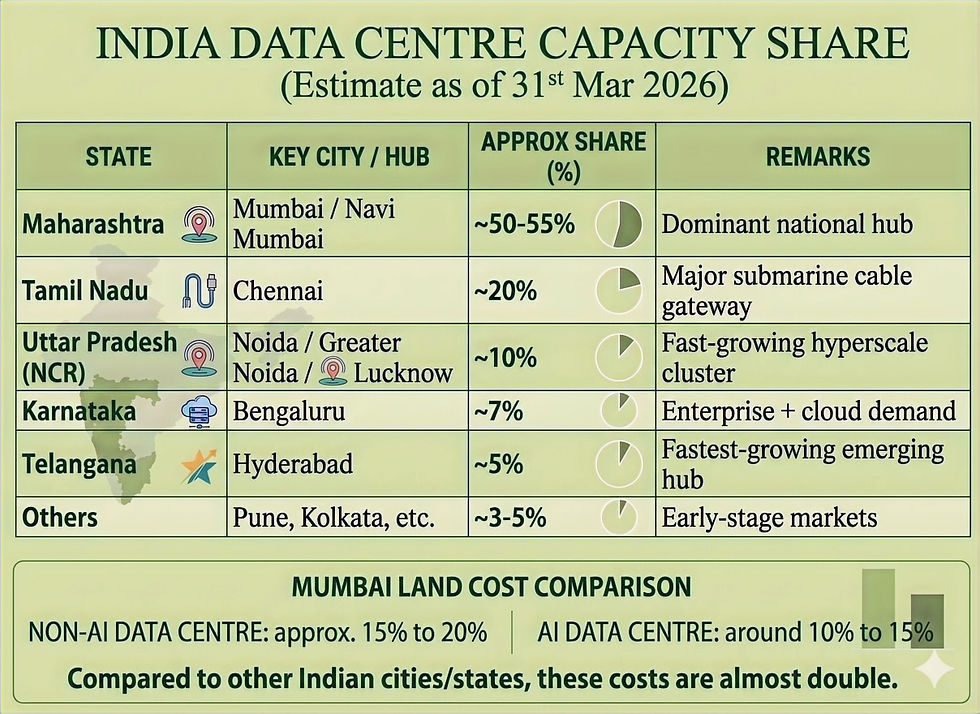
Based on our understanding of the ecosystem, India’s data centre landscape is shaped by distinct state-level strengths. Uttar Pradesh and Telangana stand out as cost-efficient, land-rich destinations, making them ideal for hyperscale developments. Maharashtra and Tamil Nadu offer robust connectivity and mature ecosystems, positioning them as key infrastructure hubs. Karnataka presents a balanced mix of progressive policy support and a strong technology backbone, while Delhi NCR, despite being a major demand centre, continues to evolve in terms of policy depth.

India Data Centre Policy,2026
India’s policy landscape is rapidly evolving to position data centres as a core infrastructure priority—driven by fiscal incentives, power accessibility, and long-term sustainability goals.
Tax Incentives — a structural shift
Long-term tax holidays (20–30 years) for eligible operators and foreign cloud providers are reducing uncertainty and creating a more predictable investment environment for global hyperscalers.
Infrastructure Status & Power Focus
Data centres are increasingly being classified as critical infrastructure, with policy support centred around power access—through electricity duty exemptions, open access to renewable energy, and dedicated power feeders. Power availability continues to be the single most decisive factor in site selection.
Land & Capital Incentives
States are enabling development through subsidised land, capital support for large-scale projects, and the emergence of data centre parks with plug-and-play infrastructure—signalling a clear shift toward ready-to-deploy sites.
Sustainability Push
Policy frameworks are placing growing emphasis on renewable energy integration, efficient cooling technologies, and water optimisation—accelerating the transition toward greener, more sustainable data centre ecosystems.
Why Policy Matters
India’s data centre capacity has scaled rapidly—from approximately 375 MW in 2020 to ~1.5 GW in 2025—and is expected to reach ~1.7 GW by 2026 and nearly ~8 GW by 2030.
Despite generating nearly 20% of global data, India currently accounts for only ~3% of global data centre capacity, highlighting a significant gap—and a compelling opportunity for future expansion.